The Top 5 Smartest Lizards Revealed!
Reptiles often get a bad rap for being simple or instinct-driven, but many lizards showcase surprising levels of intelligence. From problem-solving to recognizing individuals and adapting to complex environments, these scaly creatures challenge what we think we know about “cold-blooded” minds.
In this post, we’ll explore the top 5 most intelligent lizard species in the world, based on scientific observations, studies, and real-world evidence. We’ll start with the broader consensus on standout smart lizards, then share our personal favorites at Expedition Reptile LLC — the ones we work with every day and bring to shows across New England.
1. Monitor Lizards (Varanus species)
Widely regarded as the smartest lizards on the planet, monitor lizards top nearly every list of intelligent reptiles. Species like the Komodo dragon, Nile monitor, and Argus monitor demonstrate remarkable cognitive skills: they can learn to count (up to six in some zoo studies), solve novel problems quickly, remember complex routes, and even display distinct personalities.
These large, active predators use their keen senses and curiosity to hunt efficiently, adapt to diverse habitats, and interact with their environment in sophisticated ways. Researchers have noted their ability to tackle puzzle-like tasks, such as opening devices to access food, in record time. Their brain structure and behavior often draw comparisons to more advanced animals, making them the undisputed champions of lizard intellect.
(While we admire monitors for their incredible smarts, we don’t work with them in our programs due to their size and specific needs.)
2. Argentine Black and White Tegu (Salvator merianae)
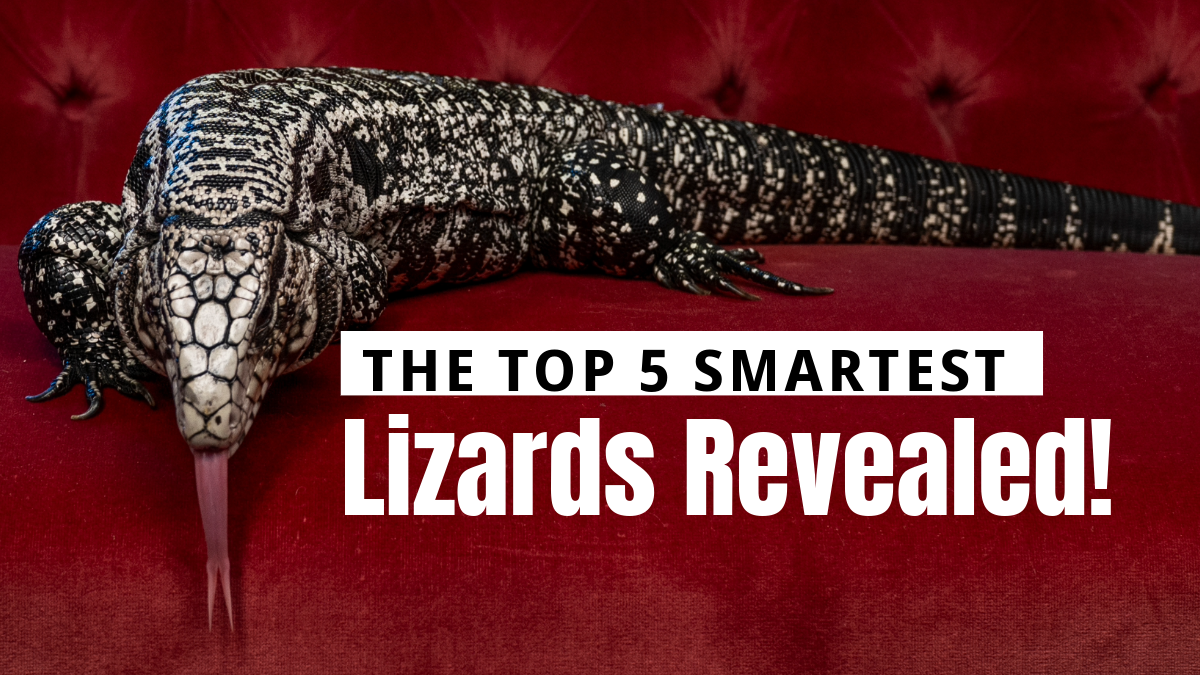
Tegus rank right up there with monitors as one of the most intelligent lizards, especially among popular pet species. These South American giants show advanced problem-solving, associative learning, and even the ability to be trained with positive reinforcement — much like dogs in some ways.
Tegus recognize their owners, learn routines, and exhibit curiosity-driven behaviors. Some have been observed figuring out escape routes, responding to cues, and displaying social hierarchies. Their high activity level and adaptability highlight their sharp minds.
At Expedition Reptile, we absolutely love our tegu — she’s incredibly intelligent, cuddly, and a total star at our shows! We bring her out to interact with audiences, where she charms everyone with her gentle nature and quick responses. Watching her engage reminds us how rewarding these brilliant lizards can be.
3. Green Iguana (Iguana iguana)
Green iguanas prove that intelligence isn’t always about size or speed — these arboreal herbivores display impressive social and communicative skills. They recognize people, remember routines, and use a rich repertoire of signals like head bobs, dewlap extensions, body postures, and gestures to express emotions, establish dominance, or communicate needs.
In the wild, young iguanas form cooperative groups, and in captivity, they can learn to respond to cues and even show problem-solving in familiar environments. Their ability to “talk” through body language is particularly fascinating.
We bring our own green iguana, Sweetpea, to many of our events. He’s highly intelligent and communicates with us through a series of head bobs, gestures, and postures — something we love demonstrating during shows to highlight how expressive and aware these reptiles truly are.
I was fortunate enough to capture a video of Sweetpea telling me with a head bob that he is going to move closer to me, and then he did. I have been studying Iguanas “language” for years and I have found a universal language that they use with these head bobs … it’s really quite fascinating! have a look at the video.
This is a video of Sweetpea telling me he is going to come closer to me!
4. Emerald Anole (Anolis evermanni or similar species)
Small but mighty in the brains department, emerald anoles (and some related anoles) have stunned researchers with their cognitive feats. In experiments at Duke University, these tiny lizards solved tasks involving hidden food under obstacles, showing higher-level cognition typically seen in birds or mammals.
Their problem-solving, evasion tactics, and adaptability make them standouts among smaller lizards.
5. Giant Tortoises (Chelonoidis species, often grouped with smart reptiles)
While technically chelonians, giant tortoises like those from the Galápagos often appear on reptile intelligence lists for their spatial memory, long-term learning, and navigational prowess. They remember locations, solve mazes, and exhibit individual personalities — proving slow and steady can mean smart too!
These top species remind us that intelligence in reptiles comes in many forms: predatory cunning, social communication, quick learning, and more.
At Expedition Reptile LLC, we specialize in bringing these amazing animals — especially our super-smart tegu and communicative green iguana — directly to you for hands-on, educational experiences. We travel throughout New England (Massachusetts, New Hampshire, Vermont, Maine, Connecticut, and Rhode Island) to schools, birthday parties, libraries, summer camps, fairs, and more, sharing facts, dispelling myths, and letting people interact safely with reptiles.
Seeing these intelligent creatures up close sparks curiosity and wonder in audiences of all ages. If you’re ready to experience the magic of these smart reptiles firsthand, book a show with us today! Head over to our booking page to reserve your spot and create an unforgettable event.
We can’t wait to share our passion — and our cuddly, clever stars — with you! 🦎